Abstract
Generative images are changing how the question of authorship is posed in photography. As images increasingly take shape through workflows comprising models, tools, and platforms, a work is shaped not only by an individual's intentions but also by a system's continuing operation and the collaboration of multiple people. A particular output is often only a provisional result of this process. Drawing on Edwin Hutchins's theory of distributed cognition, this article understands creation as a series of transformations of representations across participants and media. It also introduces the concept of the “Agent Harness” to designate workflows that project participants explicitly organize and can revise beyond the model, including arrangements for tool use, memory retention, feedback loops, and access controls. Within this framework, five cases distinguish the different points at which authors intervene in the formation of a work. The article argues that, in generative image art, authorship is manifested both in how creators help establish the conditions of a work's production and in the responsibility they bear for the consequences. For photographic theory, the question extends beyond attribution of a single image to who arranges the conditions under which images are generated, revised, and displayed.
Keywords: authorship; distributed cognition; Agent Harness; generative images; photographic theory
Introduction: Where Does Authorship Take Place?
In photography, authorship has never been merely the name on a credit line. From choosing a subject and gaining access to a site to selecting negatives, sequencing images, and determining how they are exhibited, a work depends on a chain of connected steps. These steps sometimes carry forward the individual judgment of the photographer or artist and are sometimes shared among many people; individual judgment and collaboration often intertwine. As Howard S. Becker long ago observed, artworks generally emerge through the combined efforts of creators and collaborators, institutional conventions, and technical conditions[1]. For a long time, these divisions of labor and relations of dependence have often been subsumed under stable roles such as “photographer” or “artist,” making a work appear to be the direct product of individual talent. Generative images make these once less visible relations both more complex and more conspicuous. Some projects today involve not only photography, retrieval, prompt-based generation, local revision, comparison of versions, and distribution through platforms, but also model design, data preparation, software development, and platform operations. Photographers, artists, editors, designers, engineers, scientists, and the companies providing models and platforms may all participate at different stages. Meanwhile, an image gradually takes shape through repeated generation, selection, alteration, combination, and presentation; it is increasingly difficult to understand it as a final state fixed by a single exposure. How a work comes into being therefore depends both on the judgments of its participants and on how those judgments are connected and organized.
Against this background, discussions of AI and authorship often focus on the question, “Once a machine is involved, can a human still count as the author?” This question generally treats the work as a stable object first and then asks whose name should be attached to it. Yet in generative image art, decisions and collaborations involving different participants may be involved at every stage: from preparing data, choosing tools, and designing a method of generation, through retaining, modifying, and combining intermediate results, to bringing a final version into public view. The scope of the data, the choice of tools, the division of collaborative labor, the criteria for selection, and the mode of display continue to shape the work at different stages.
Roland Barthes's account of the “death of the author”[2], Michel Foucault's analysis of the “author function”[3], and Vilém Flusser's discussion of the photographic apparatus[4] offer different perspectives on attribution, discursive position, and technical apparatus in the production of images. Generative images make the relations these theories address more complex, and more visible, under new technical conditions: throughout its formation, a work is affected by models, platforms, collaborators, and mechanisms of evaluation. Describing how authorship is distributed among these stages calls for an analytical language that can connect photographic theory with contemporary technical practice.
This article therefore asks: at what points does authorship manifest itself in generative image art? The following discussion considers how creators organize data, tools, collaborative relationships, selection criteria, and conditions of display, and how responsibility is redistributed through these arrangements. It first examines the conditions on which the formation of a work depends. It then builds an analytical framework using distributed cognition and the concept of the Agent Harness, uses five cases to distinguish different points of authorial intervention, and finally returns to photography to consider the theoretical implications.
The five cases examine where authors intervene through archival extraction, the direction of successive rounds of generation, the governance of digital identity, a system operating in real time, and the organization of a debate itself. They are not intended to exhaust every possibility. Two criteria guide their selection: each case must involve, directly or indirectly, the production, use, or display of photographic images, so that it has a substantive connection to photographic theory; and the cases must differ in the point of intervention they illuminate, thereby addressing distinct questions raised when models participate in creation. On this basis, Jon Rafman and Boris Eldagsen belong to a relatively direct photographic context; Holly+ and Refik Anadol's work lie in fields adjacent to photography, concerning digital identity governance and a system operating in real time, respectively; and MT's AI Art Is (Not) Art makes the organization of debate itself part of the work.
I. How a Work Comes into Being
The question of authorship in photography has long been approached through a work's final form. Whether the work is a single photograph, a sequence, or a photobook, once it appears as a print, a file, a book page, or an exhibition wall, discussion tends to focus on attribution, originality, and interpretive authority. The process by which the work was made can recede behind the finished object.
Yet these works already pass through a series of judgments before becoming finished objects. A single photograph involves capture, selection, and post-processing; a sequence or photobook also makes selection, order, facing pages, size, text, and the rhythm of display part of its form. In many projects, exchanges among editing, design, proofing, and printing continue to change the relationships among images. Analysis of authorship therefore cannot stop at final form: such judgments may extend across many stages, even though attribution is still often assigned to the work as finally presented.
Generative images make the boundary between the finished object and the process of its formation harder to draw. An image often takes shape across multiple rounds of generation, local revision, and comparison among versions; some projects even center on a continuously operating system, for which any particular output is only a provisional result. Discussion of authorship thus takes in more specific questions: what conditions allow a given result to appear, what mechanisms determine whether it is retained or discarded, and how it eventually enters channels of viewing and circulation.
The formation of a photographic work has always involved connected stages. Darkroom procedures, contact sheets, archive boxes, and editing tables can carry a photographer's or artist's individual judgments across different phases. Picture agencies, editors, retouchers, publishers, and curators may also share the labor required to form a work within a single project; these two situations often overlap. Photobook production makes the relationship between individual judgment and collective work especially clear. In many projects, photographers and editors repeatedly adjust relationships among images through contact sheets, wall edits, and book dummies, while designers, prepress workers, printers, and publishers may contribute to the work's final form through layout, paper, color, printing, and binding. In other projects, the photographer or artist performs several of these tasks. Every proof and round of feedback can return images to selection and sequencing, although the division of labor among participants may not be fully reflected in the final credits. What generative technologies change is that judgments about image selection, stylistic direction, and pacing may also be encoded in prompt templates, parameters, retrieval rules, tool permissions, and evaluation criteria. Engineers, scientists, and platform providers thereby participate in forming the work. Analysis of authorship must therefore examine both who makes particular judgments and how those judgments enter the processes of image production, selection, and display.
How materials enter the workflow, how tools are called, how images are selected, sequenced, and retained, and how they take particular form on a book page, exhibition wall, webpage, or in an installation together determine how a work comes into being. Authorship is distributed among the judgments, negotiations, and configurations at these stages, along which responsibility can also be traced.
II. Distributed Cognition and the Transformation of Representations
Analyzing how authors intervene in the formation of a work requires a theoretical tool capable of describing how cognition is distributed through the creative process. Edwin Hutchins's theory of distributed cognition provides an important point of entry[5]. It expands the unit of analysis from an isolated individual to a system comprising participants, tools, representations, and environment. Completing a task depends both on the division of labor among participants and on how external representations, such as records, interfaces, and classification schemes, preserve and reorganize information. Cognitive activity also extends across time: records and results from one stage become the basis for judgment at the next. Cognition is thus distributed among people, between people and tools, media, and environments, and across successive stages of work.
In Hutchins's classic study of navigation aboard a naval vessel, navigation constitutes just such a cognitive system. Taking bearings, recording, plotting, calculating, communicating, and steering are undertaken by different crew members and devices. Readings are repeatedly transformed among spoken commands, written records, calculations, and marks on a chart, ultimately producing a positional judgment that can guide steering. Each stage handles only part of the task; navigation is completed through their coordination. Applied to authorship, this theory directs attention to concrete stages: which participants take part in judgments, which tools and representations preserve or transform those judgments, and how the result of one stage constrains the next. It thereby enables us to identify authorship within the process of creation rather than attributing it vaguely to individual intention alone.
This approach is particularly apt for contemporary image production. Depending on the project, transformations of representations may include a scene being recorded by a camera as raw data; raw data becoming previews and thumbnails in software; thumbnails being selected, grouped, or tagged; and tags entering prompts, search queries, or editing instructions, after which generated results return to the level of the image for local revision. When images enter a sequence or photobook, they may undergo further selection, ordering, cropping, placement across facing pages, layout, and proofing. They continue to take shape through relationships among images and between images and material form, before appearing as a book, exhibition wall, webpage, or installation. Each transformation retains some information, discards some, and gives new emphasis to some. In certain generative workflows, transformations accumulate further: one model's output becomes another model's input, and the work gradually emerges as different media and interfaces continue to process the results of earlier rounds.
In a photographic context, these transformations of representations can be understood as an “expanded editing table.” The editing table once dealt principally with negatives, contact sheets, wall edits, book dummies, and press proofs. Today, editing may also involve prompt templates, version logs, semantic tags, and masked regions; a platform's moderation rules can also affect which versions circulate. A photographer's or artist's judgments can thus be carried out through a wider range of tools and operations, while authorship is manifested in the choices made across these transformations.
Distributed cognition allows analysis of authorship to attend to specific relationships among participants, tools, and representations. The choices different people make at points of transformation, the constraints that external records place on later judgments, and the ways these stages connect all shape the work. How crucial points of transformation are organized is therefore an important clue to authorship.
III. The Agent Harness: An Organizational Layer Beyond the Model
Distributed cognition shows how judgments and representations circulate during creation. On this basis, we must further identify the arrangements that allow these stages to be connected, repeated, and adjusted. Recent discussions of the “Agent Harness” in agent engineering offer a concept for describing such arrangements. In an engineering article on long-running applications, Anthropic observes that keeping a model stable over tasks lasting several hours often requires external orchestration, including task decomposition, structured handoff documents, and a division of labor between generators and evaluators[6]. OpenAI describes Harness Engineering as an “agent-first” engineering practice in which human work shifts from writing code directly to designing environments and feedback loops[7]. LangChain summarizes the relationship as “Agent = Model + Harness,” understanding the harness as execution logic beyond the model that gives it state, tool-use capabilities, and constraints[8]. All three suggest that a model's ability to sustain a task also depends on an organizational layer beyond the model.
This article uses the term “Agent Harness” to emphasize its function of organizing a workflow. Here, the “harness” consists of arrangements beyond the model: it supports the model's continuing operation and determines how the model accesses tools, retains memory, receives evaluation, and moves to the next step. Darkroom practice offers an analogy for the relationship between model and harness. The harness relates to the model much as printing notes relate to an enlarger. The enlarger produces the image, while the notes record the areas of each negative to dodge or burn, the contrast grade, and the development time; they also provide a reusable point of reference for assessing test strips and retaining proofs. The notes do not themselves produce an image, but they continue to affect the photograph that ultimately leaves the darkroom. Written on paper, they can be consulted and revised.
The Agent Harness as used here does not include every stable media structure involved in creation. It refers specifically to workflows that project participants explicitly organize and can inspect and revise. Such arrangements may take the form of prompt templates, configuration files, evaluation criteria, permission lists, or operating rules. They act directly on the transformations of representations discussed above: they may determine how text enters a model, on what basis an output is evaluated, and which intermediate results are retained. They thus give the movement of representations described in the previous section the form of workflows that can be examined and modified.
The Agent Harness shares some ground with what Flusser calls the photographic “apparatus.” Flusser argues that the camera's programme defines in advance the range of choices available to the photographer, who acts within the apparatus while trying to exhaust or subvert its programme[4]. This account remains pertinent to generative images: a user of a diffusion model is likewise constrained by the model's latent space, training distribution, and interface defaults. Flusser's central concern is how photographers act within the possibilities prescribed by the camera's programme. Actual generative image practices, however, frequently involve models, interfaces, retrieval systems, evaluation procedures, and deployment platforms at once. The Agent Harness lets us examine how these stages are coordinated: which tools are connected, in what order they operate, how intermediate results circulate, and when a person must intervene. When creators participate in arranging these relationships, the arrangements themselves become part of the analysis of authorship.
Workflows explicitly organized by project participants also depend on wider technical and institutional conditions. This article draws on infrastructure studies to examine that dependence. Susan Leigh Star and Karen Ruhleder understand infrastructure as a set of relations accessed and relied upon in specific practices[9]. From the standpoint of an individual creator, infrastructure consists of technical and institutional conditions already integrated into their work and supporting it, yet not directly arranged by them. The provenance and classification of training data, model platforms and their interfaces, account permissions, moderation rules, and publication channels all affect image production in different ways. They often recede into the background in everyday use and become conspicuous when failures or disputes arise[10].
An Agent Harness is usually built on such infrastructure. Parameters, interfaces, and permissions made available by a platform can be incorporated by project participants into their own workflows; the platform's underlying data, rules, and maintenance mechanisms remain infrastructure on which they depend. The power to configure an arrangement can help determine whether it belongs to the harness, but the fact that something can be modified does not, by itself, make an entire platform an Agent Harness. In Google Street View, for example, Rafman can use the images provided by the system but cannot help set its capture protocols, stitching algorithms, or geographical coverage; for his practice, these conditions constitute infrastructure. Whether his subsequent selection, archiving, and presentation constitute an Agent Harness depends on whether those stages have been organized into an explicit, revisable workflow.
Lucy Suchman's discussion of agency helps explain why these technical arrangements matter to authorship. She understands action as an outcome arising from specific relationships between people and technologies, rather than as a fixed property possessed by either in advance[11]. This view does not itself decide who is an author, but it cautions against assigning all agency to the person or the machine beforehand. Becker's theory of art worlds further shows that a work emerges through divisions of labor among creators, collaborators, institutions, and technical conventions[1]. Following these two lines of thought, authorship in generative images can be located in actual decisions within the workflow: who writes prompts, who decides which records to retain, who sets permissions for tool use, and who establishes evaluation criteria. Some of these judgments and divisions of labor are also encoded in prompt templates, configuration files, permission lists, and evaluation procedures, leaving traces that can be inspected and revised. Judgments that are not formalized still need to be analyzed in relation to actual operations and collaborative relationships.
Within the creative process described by distributed cognition, the parts that project participants can explicitly configure can be examined through the Agent Harness. Specific arrangements within a harness may include how tasks are divided and resumed, how tools and external knowledge are called upon, which evaluation criteria and human review steps act as constraints, which versions and intermediate results are preserved, and what kinds of outputs may proceed to publication, exhibition, or further training. These arrangements shape the work's form and boundaries and offer clues for tracing responsibility.
IV. Archival Extraction: Jon Rafman and The Nine Eyes of Google Street View
Jon Rafman's The Nine Eyes of Google Street View is often regarded as an important example of post-photography or database photography. Since 2007, Google Street View has continuously photographed roads using vehicles equipped with multiple cameras, creating a vast archive of automatically captured streetscapes[12][13]. Rafman works at his desk, far from the sites of capture. He has spent years browsing Street View images, selecting and extracting scenes he considers “worthy of becoming photographs,” gradually building an archive that continues to grow and resequencing the images in particular presentations, including slideshows and exhibitions[13].
This project extends the point of authorial intervention from on-site capture to the selection and recontextualization of existing images. How Street View images are captured, processed, and updated depends on the camera angle and height, update frequency, face-blurring policy, and geographical coverage set by Google. Rafman does not participate in setting these conditions. His work is to select, extract, and name frames from an immense automated image stream, then bring them into his own archive and presentations.
This form of authorship is familiar in photographic practice. Selecting images from a contact sheet has long been an important part of authorship. The character of many canonical photographers' bodies of work likewise depends on which images they retained and which they discarded from among many similar frames, not solely on the moment of capture. What distinguishes Rafman is that his “contact sheet” is made up of Google's continuously updated machine images rather than his own exposures.
After extraction, archiving, sequencing, and juxtaposition continue to shape the relationships among images. The same Street View image acquires a different place and reading rhythm alongside different neighbors; as the project continues to develop, the archive's boundaries and the combinations used in particular presentations also change. Rafman's editing thus connects two stages: selecting photographs from the Street View image stream and establishing relationships among them through archiving and specific forms of presentation.
From the perspective of distributed cognition, Rafman's judgments are concentrated at two connected transformations of representations: a scene in Street View is extracted and designated a photograph, and that photograph enters the work through archiving and specific arrangements. Google's infrastructure and Rafman's own working arrangements are both present here. Google maintains the capture protocols, stitching algorithms, interface design, and geographical coverage; Rafman can organize the subsequent selection, storage, and presentation. Whether these latter activities also form reusable, revisable rules requires a separate judgment. What this case shows is how an author redistributes visibility through recognition, naming, archiving, and sequencing within the limits set by an existing system.
V. Directing Successive Rounds: Boris Eldagsen and Pseudomnesia: The Electrician
While Rafman mainly selects and arranges images after they have been produced, Boris Eldagsen brings authorial judgment into multiple rounds of image generation. In 2023, after the Sony World Photography Awards announced its winners, Eldagsen publicly declined the award and explained that his work Pseudomnesia: The Electrician had been generated with AI. In his view, AI images and photographs should not compete for the same award because they are “different entities”[14]. The event confronted the photographic field with a more specific question: what exactly does an author do when an image takes shape through several rounds of generation and local revision?
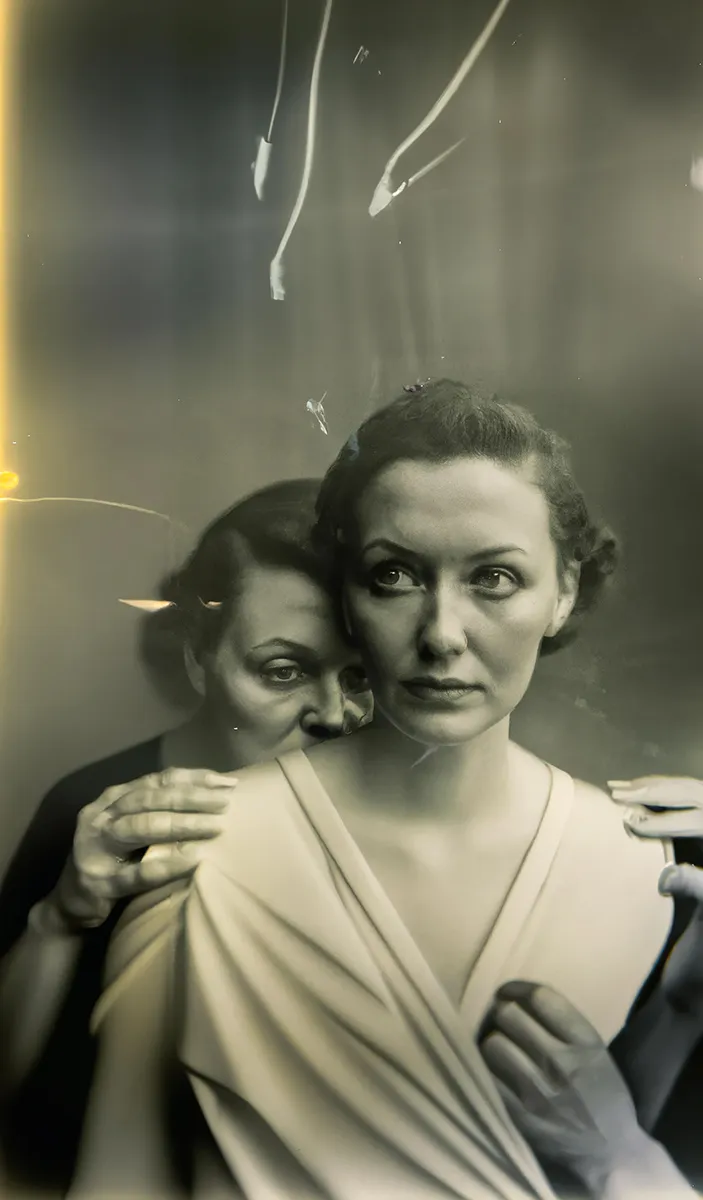
According to an interview by Foster, the making of Pseudomnesia: The Electrician involved approximately twenty stages[15]. Eldagsen first used text-based generation to establish the relationship between two female figures, their expressions, and the emotional tenor of the image, while also specifying its period feel, lens, shutter, lighting, composition, and resolution. He then extended the image at its edges through outpainting and used inpainting to alter clothing, the figures' positions, and details, gradually producing an image with the character of 1940s photography. Prompts were one part of the process; the image's particular appearance also depended on how the rounds progressed, how tools were switched, and which results from each round were retained or rejected.
Eldagsen's long experience of photography and art history also entered into this ongoing process of looking, judging, and revising. In the interview, he notes that this experience informs how he formulates verbal instructions[15]. His grasp of lens effects, period style, lighting relationships, and visual rhetoric thus enters each round of adjustment.
Viewed through distributed cognition, these twenty stages are not homogeneous “iterations.” They include at least three distinct kinds of transformation of representations: text to image, as a model translates a prompt into an initial image; image to image, as outpainting and inpainting alter the existing composition; and image back to text, as the artist studies a generated result and reformulates the instructions for the next round. Following these transformations shows how authorial judgment enters the generative process. The model performs each round of generation; after seeing its result, Eldagsen organizes the next instruction and decides when to stop revising. His experience enters the making of the image concretely through those subsequent instructions and the decision to stop.
From the perspective of the Agent Harness, what Eldagsen can chiefly arrange are prompts, tool selection, the order of operations, and the choice of results. Different platforms provide the underlying models, interfaces, and generative functions, but within the possibilities these tools allow, he largely decides how each round proceeds. Prompts and the sequence of operations leave records that can be revisited, while his criteria for retaining or discarding a round's results reside more in evaluative habits formed through repeated practice. This case therefore shows how he guides the image's formation without allowing every choice to be reduced to an explicitly written rule.
VI. Governing Digital Identity: Holly+
Eldagsen's judgments concern how a single image takes shape. Holly+ shifts the question to how an artist's digital identity is used and governed by others once a model is made available. Centered on Holly Herndon's voice and digital persona, the project was developed by Herndon, Mat Dryhurst, and technical collaborators including Never Before Heard Sounds. They trained a generative model on Herndon's voice material, allowing others to create with that voice model, and organized official certification and revenue sharing through a DAO[16][17].
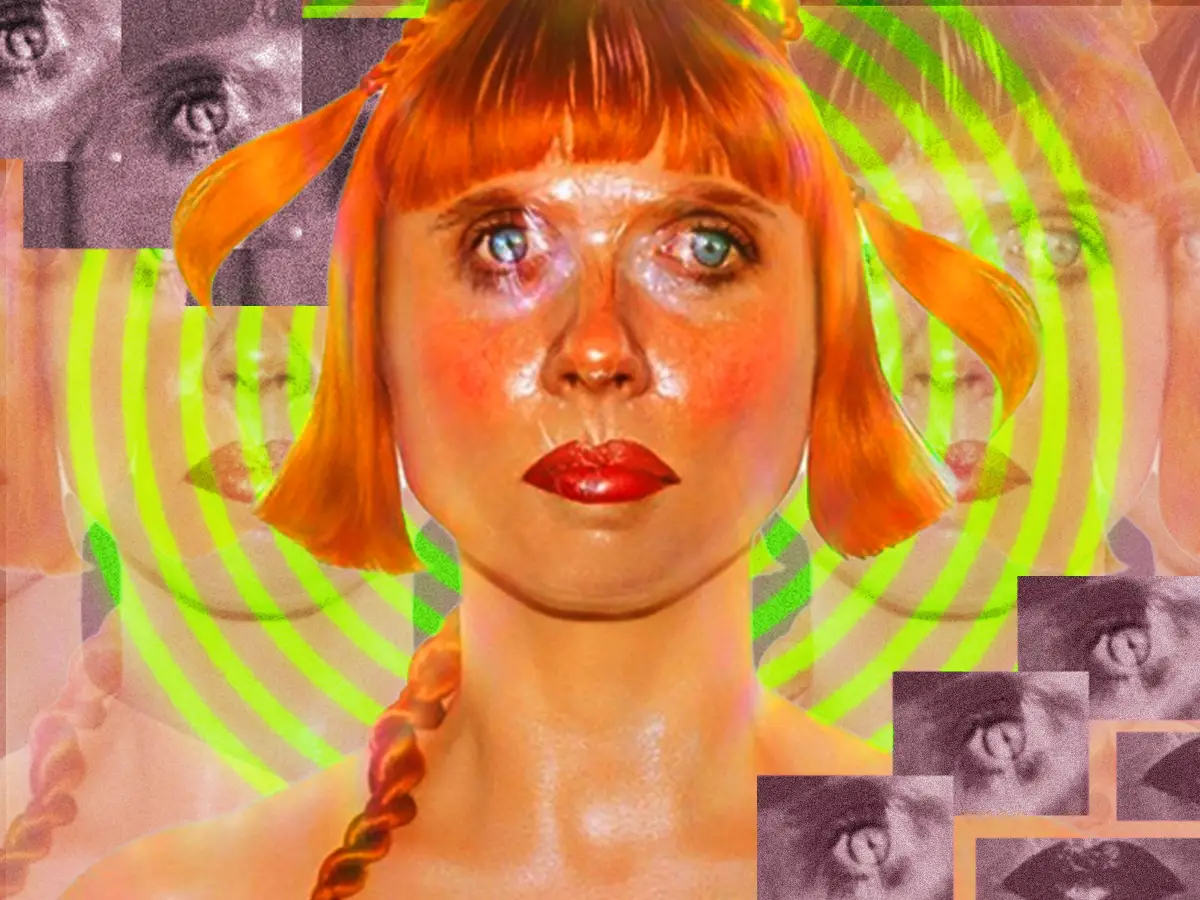
This case extends the question of authorship to identity, training, authorization, and governance. Anyone can use the tool to create and submit a work, and submission does not prevent creators from continuing to use their own work. The DAO determines which works receive official recognition and are minted and auctioned; the proceeds are then divided according to predetermined proportions among the work's creator, the DAO, and Herndon[16][17]. Creating with the model, receiving official certification, and taking part in revenue sharing are therefore related but distinct stages.
Photographers or artists who train style models on personal archives, or make models available for others to use, face similar questions: whose images underlie the model, whether its outputs require certification, how revenue is distributed, and who addresses misuse. Holly+ is instructive because, after a digital identity is opened to others, the author and other participants must still arrange which works receive certification and how revenue flows back.
From the perspective of the Agent Harness, Holly+ also establishes DAO review rules and auction contracts beyond the model. Herndon and her technical collaborators train the model and develop the tool, the DAO reviews works for official recognition, and the contracts implement revenue distribution[16][17]. Different participants thus play different roles in creation, certification, and revenue sharing. How a digital identity is used and recognized also becomes part of the work. The next section turns to another form of organization in Unsupervised: how a system continually generates and responds to its environment at an exhibition site.
VII. A System Operating in Real Time: Refik Anadol's Unsupervised
Refik Anadol Studio's Unsupervised extends the question of authorship to a system operating in real time at an exhibition site. Drawing on the collection data of the Museum of Modern Art (MoMA) in New York, Unsupervised uses AI to generate continually changing visual forms, surrounding viewers in a large-scale installation[18]. According to the studio's project description, the team processed approximately 138,151 images from MoMA's collection and used StyleGAN2 ADA together with the “Latent Space Browser,” which the studio has developed since 2017, to generate new visual states[19]. Lighting, the movement of people, acoustic conditions within the exhibition, and outdoor weather also affect the changing images and sounds[18].
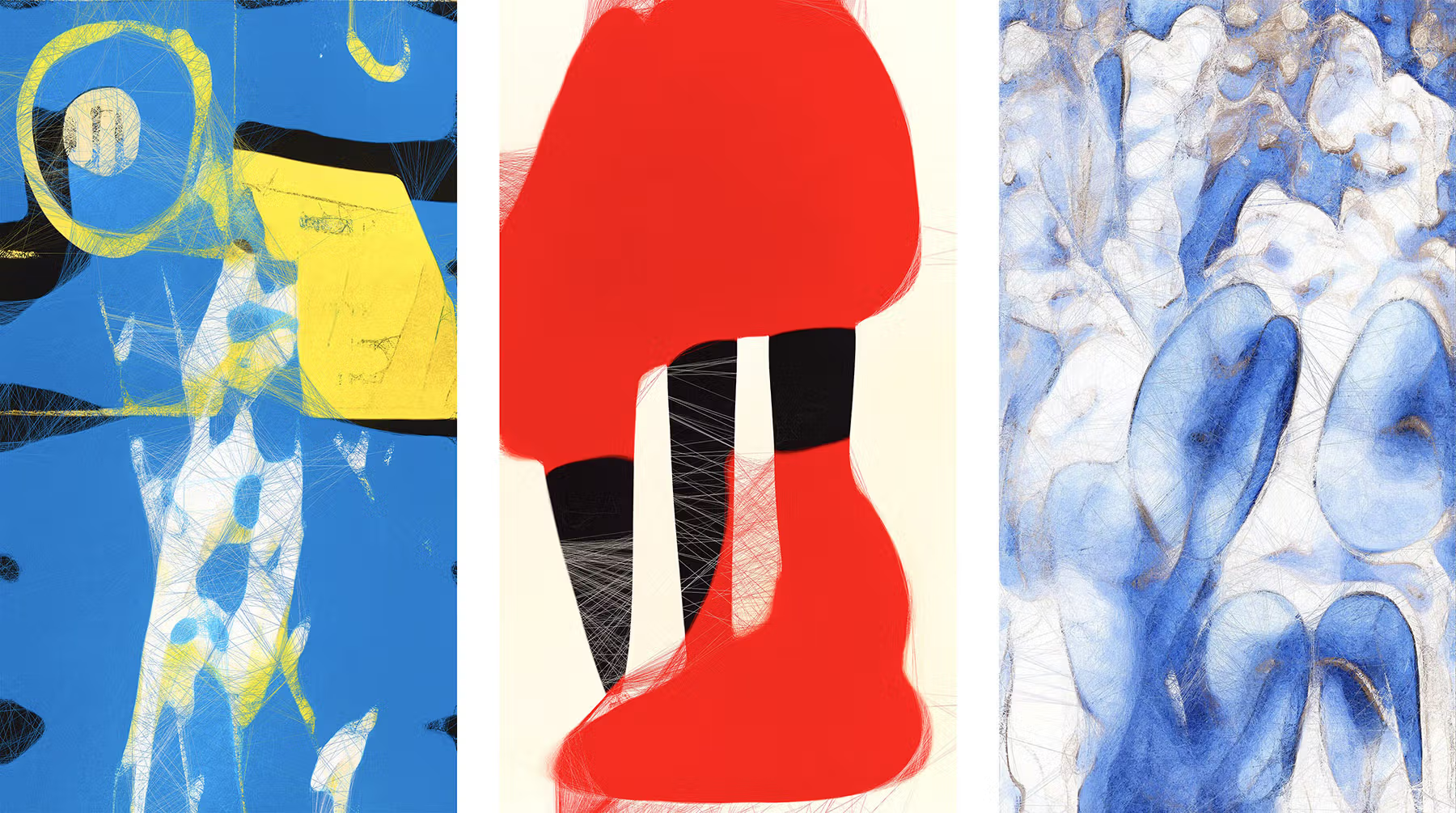
At the heart of this work is a trained and deployed system capable of continually updating visual states on site. Members of Anadol's studio, MoMA's curatorial team, and technical partners providing software and computing systems all participated in its realization[18][19]. An analysis of authorship thus involves the construction of the system, the division of labor within the team, and the design of on-site conditions, as well as the formation of particular outputs.
From the perspective of distributed cognition, Unsupervised shows how transformations of representations continue across time and space. MoMA's collection data enter model training after digitization, classification, and encoding. The resulting latent space is navigated and used through custom software, and finally presented to viewers through moving images, sound, and the gallery environment. Collection organization, model training, software development, exhibition planning, and environmental response are distributed among different people, institutions, and technical systems. The work's operation depends on these stages remaining connected. The visual rhythm experienced by viewers is shaped jointly by rules written in advance, real-time computation, and on-site inputs.
From the perspective of the Agent Harness, one can identify a layer of operating arrangements configured by the studio. These include the custom “Latent Space Browser,” rules for real-time generation, environmental inputs, and the means by which images and sounds enter the display system. The collection data, StyleGAN2 ADA, software and computing systems supplied by NVIDIA, and MoMA's exhibition conditions likewise affect the work, but not all of these fall within the studio's power to configure. Distinguishing who can configure these conditions clarifies where the studio, curatorial team, and technical partners each participate in forming the work.
This still leaves a question: to what extent are the emergence, merging, and dissolution of forms choreographed by rules in advance, and how many of their features arise from traversal of the latent space and environmental response? Both factors may be present in actual operation. Distinguishing them helps assess how different participants influence the temporal structure of the output. For photographic theory, a work of this kind makes the question of authorship encompass system design, team collaboration, and the organization of rhythm. The final case shifts the angle of observation: it centers on how a debate is organized by a system, rather than on visual rhythm.
VIII. A Recursive Structure of Debate: MT and AI Art Is (Not) Art
MT's AI Art Is (Not) Art brings together large language models, a multi-agent framework, voice cloning, 3D modeling, and 3D printing. At the exhibition site, opposed arguments spoken in a cloned voice play continuously[20]. The work organizes the debate over whether AI art is art into an installation that remains in operation. As a machine continually generates arguments for and against AI art in the artist's voice, identity and the position from which speech is uttered are also reorganized. Compared with the preceding cases, this work makes the way the debate is organized by a system part of what is presented; the Agent Harness thus becomes part of the work's statement.
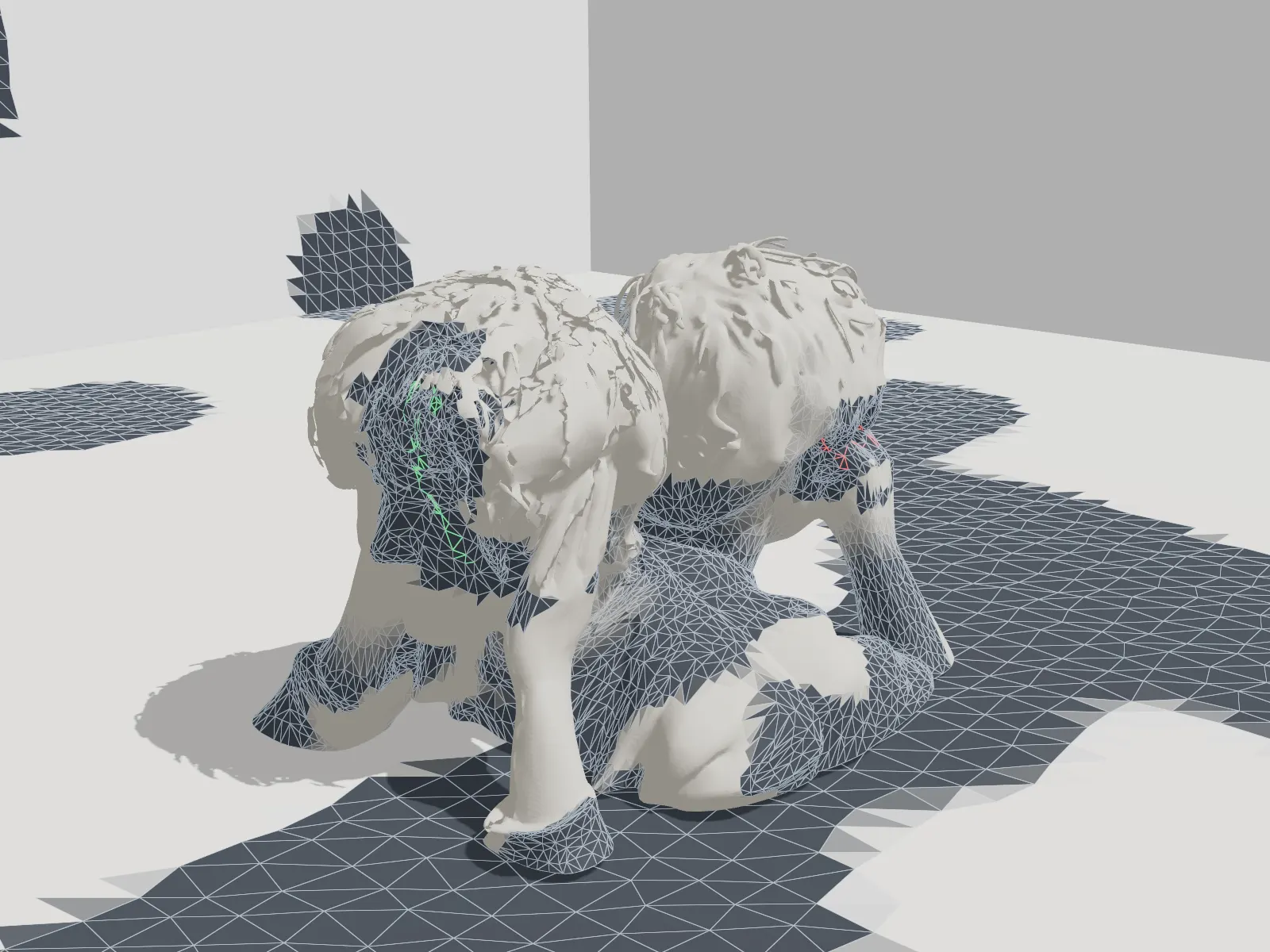
Different agents within the system speak from different positions. A language model continually generates arguments supporting and challenging AI art; a voice model translates them into audible statements bearing traces of the author's voiceprint; and a 3D replica in the physical installation further materializes this recursive debate. Together, these elements form an operating structure in which different voices remain in conflict and challenge one another without being brought to a simple resolution.
At the level of harness configuration, most of this work's crucial authorial decisions precede the system's operation and exist as settings that can be identified individually. The first is the assignment of positions: before each agent enters the debate, its stance is specified by a system instruction. The second is the organization of memory: the history of the debate accumulates and is fed back to both sides, so subsequent arguments must address those already made. Recursion thus becomes a concrete mechanism.
The third configuration is the absence of a global condition for convergence. The system has no evaluator charged with finally deciding a winner, nor a stopping criterion for declaring that “the debate has gone far enough.” Section V asked how Eldagsen decides that a result can pass to the next round; here, the artist has written “no final judgment” into the harness. This does not rule out local evaluation during each round of generation, but the system does not end the debate when one side wins.
The fourth configuration is voiceprint mapping: statements for and against AI art are mapped onto the same vocal source, the artist's cloned voiceprint, so the question of “who is speaking” cannot be settled by listening alone. Both positions issue from clones of “the author,” yet neither can be directly equated with authorial intention. At the level of configuration, the artist arranges who may speak, with what voiceprint, under what conditions the debate continues, and how viewers encounter it in space.
The system's structure is relatively clear in this case. Particular statements can change indefinitely; tomorrow's arguments may differ from today's while the work retains its identity. Following the configurations within the harness, authorship can be located at several specific points: assignment of positions, feeding back memory, absence of a global convergence condition, and voiceprint mapping. The configurations governing the system's operation keep the changing audio and 3D-printed pieces part of the same work; particular outputs are its manifestations at particular moments.
In this case, the Agent Harness both contributes to the work's formation and determines the structure in which the debate is presented.
Conclusion: How Authorship Is Distributed
The five cases above show several points at which authors intervene in the formation of a work: archival extraction, direction across rounds of generation, digital identity governance, a system operating in real time, and a recursive structure of debate. Actual creative practices often combine several of these points, and different participants may hold the power to configure and judge at different stages of the same project.
Returning to photography, discussions of authorship centered on a single finished image can push selection, editing, and presentation after capture into the background. With the addition of generative tools, a photographer or artist may organize an image archive, prepare prompt templates, and decide which intermediate results require human review. These tasks may be undertaken by one person or in collaboration with editors, designers, engineers, or institutions. Once images enter a sequence or photobook, they continue to take shape through selection, ordering, facing-page relationships, layout, paper, proofing, printing, and binding. Analysis of authorship needs to consider both how images are produced and how they are subsequently processed, combined, and presented.
Rafman redistributes visibility through selection, archiving, and sequencing; Eldagsen shapes an image by directing successive rounds, switching tools, and choosing among results; Holly+ organizes the certification and revenue relationships of a digital identity; Unsupervised involves a team coordinating the conditions of real-time operation; and MT makes the assignment of positions and the mapping of voices part of a debate's structure. These differences show that judgments about authorship depend both on which stages shape the work and on how much decision-making power the relevant participants hold at those stages.
This analysis also offers clues for discussing responsibility. Geoffrey C. Bowker and Susan Leigh Star have long reminded us that classifications and standards embed particular perspectives and produce uneven consequences in practice[21]. Prompt templates, evaluation criteria, access permissions, and training sources in generative imaging likewise affect which results can appear and circulate. The Agent Harness can help identify who set these conditions; ultimate responsibility must also be judged in light of participants' knowledge, actual control, institutional roles, and decisions about dissemination.
Drawing on distributed cognition and the concept of the Agent Harness, this article has understood creation as a series of transformations of representations across participants and media, and examined how project participants organize working conditions beyond the model. Machine participation expands the scope of authorship analysis from particular outputs to the conditions of their formation: authorship is manifested both in particular outputs and in the conditions under which they take shape. Image studies can continue to ask who arranges the conditions that allow an image to appear, who decides how it is processed, combined, and presented, who brings it into the public sphere, and which participants should bear responsibility for the consequences.
References
[1] Becker, Howard S. Art Worlds[M]. Berkeley: University of California Press, 1982.
[2] Barthes, Roland. The Death of the Author[A]. In: Heath, Stephen, ed. and trans. Image-Music-Text[M]. London: Fontana, 1977: 142–148.
[3] Foucault, Michel. What Is an Author?[A]. In: Faubion, James D., ed. Aesthetics, Method, and Epistemology[M]. New York: The New Press, 1998: 205–222.
[4] Flusser, Vilém. Towards a Philosophy of Photography[M]. Mathews A, trans. London: Reaktion Books, 2000.
[5] Hutchins, Edwin. Cognition in the Wild[M]. Cambridge, MA: MIT Press, 1995.
[6] RAJASEKARAN P. Harness design for long-running apps[EB/OL]. Anthropic Engineering, 2026-03-24. https://www.anthropic.com/engineering/harness-design-long-running-apps
[7] LOPOPOLO R. Harness engineering: Leveraging Codex in an agent-first world[EB/OL]. OpenAI, 2026-02-11. https://openai.com/index/harness-engineering/
[8] TRIVEDI V. The anatomy of an agent harness[EB/OL]. LangChain Blog, 2026-03-10. https://blog.langchain.com/the-anatomy-of-an-agent-harness/
[9] Star, Susan Leigh; Ruhleder, Karen. Steps toward an ecology of infrastructure: Design and access for large information spaces[J]. Information Systems Research, 1996, 7(1): 111–134.
[10] Star, Susan Leigh. The ethnography of infrastructure[J]. American Behavioral Scientist, 1999, 43(3): 377–391.
[11] Suchman, Lucy A. Human-Machine Reconfigurations: Plans and Situated Actions[M]. 2nd ed. Cambridge: Cambridge University Press, 2007.
[12] PROULX C. The Nine Eyes of Google Street View[J]. Ciel variable, 2013(95): 29–32.
[13] Louisiana Museum of Modern Art. Jon Rafman[EB/OL]. 2025. https://louisiana.dk/en/exhibition/jon-rafman/
[14] Eldagsen, Boris. Sony World Photography Awards 2023[EB/OL]. 2023-03-14. https://www.eldagsen.com/sony-world-photography-awards-2023/
[15] FOSTER A. Boris Eldagsen: The woman who never was[EB/OL]. Talking Pictures, 2023-04-01. https://talking-pictures.online/2023/04/01/boris-eldagsen-the-woman-who-never-was/
[16] Herndon, Holly. Holly+[EB/OL]. Paragraph, 2021-07-13. https://paragraph.com/@holly-herndon/holly
[17] Herndon, Holly. Holly+ Auction: About[EB/OL]. Holly+ Auction, 2021. https://auction.holly.plus/about
[18] The Museum of Modern Art. Refik Anadol: Unsupervised[EB/OL]. 2022. https://www.moma.org/calendar/exhibitions/5535
[19] Anadol, Refik. Unsupervised[Z/OL]. Refik Anadol Studio, 2022. https://refikanadol.com/works/unsupervised/
[20] MT. AI Art Is (Not) Art[Z/OL]. 2025. https://mt-zeng.com/ai-art-is-not-art
[21] Bowker, Geoffrey C.; Star, Susan Leigh. Sorting Things Out: Classification and Its Consequences[M]. Cambridge, MA: MIT Press, 1999.